
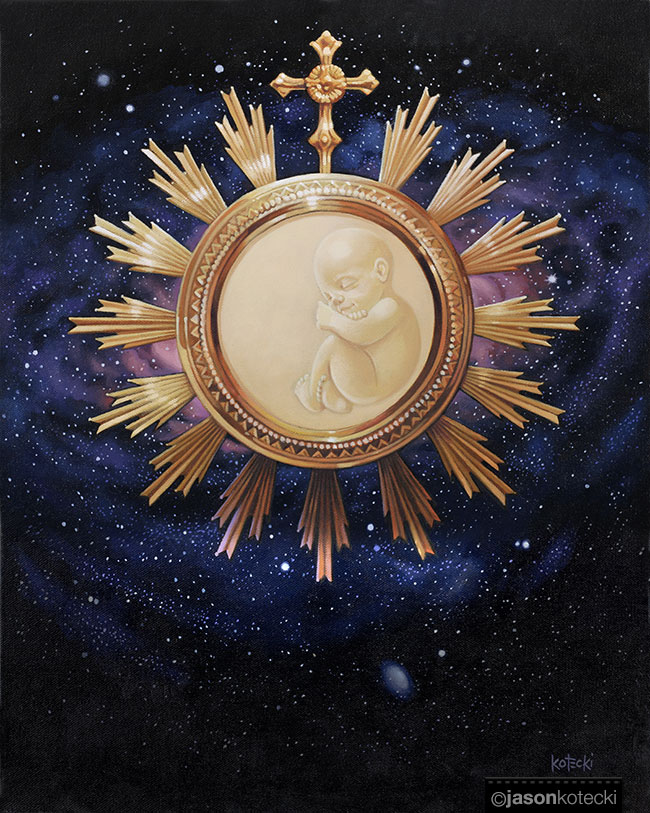
Prints available.
You are the God who works wonders.
—Psalm 77:14
Wonder has been on my mind a lot lately.
It bubbled up on a family trip to Florida as I pondered the millions of seashells piled on the beach.
Wonder is one of the core traits children possess, and something I tried to capture in the comic strip I created a few decades ago.
It’s actually been a key ingredient of everything I’ve created in my career, especially the paintings that come out of my studio and our Wondernite event.
My wife even wrote a book on it.
After all these years, I finally have an explanation for why wonder is such a big part of what we do.
I want to help people rediscover their sense of wonder so they can see God.
In his book, Living in Wonder, Rod Dreher proposes that we live in a disenchanted age and have lost the ability to perceive the world with the eyes of wonder. He says that “in the premodern past, people (not only Christians) took for granted that the natural world testified to the existence of God, or the gods.”
Nowadays, our post-Enlightenment perspective tends to view those people as naive and superstitious. We have an over-reliance on reason and often think we have all the answers. We live in a time overflowing with marvels that would have astonished our ancestors, but whose familiarity has dulled our wonder.
There is a reason the recent Artemis mission captivated so many of us, and perhaps even surprised us in doing so. “The hunger for enchantment has not gone away,” says Dreher, “because the hunger for meaning, connection, and the experience of awe is part of human nature.”
As Science has progressively demystified the natural world, we often forget that we live in a galaxy of wonders.
When we lose our sense of wonder, we lose sight of God.
Our forays into space and the photographs that return help remind us of the stunning size of the universe. It’s remarkable how the cosmic glue known as gravity serves as one of the universe’s main organizing forces, pulling matter together to form stars, planets, moons, galaxies, and clusters, and keeping those systems from flying apart.
The Earth alone is a balancing act of pressure, temperature, radiation shielding, chemistry, and biology all working together. Change one part enough, and the others get pulled off balance too.
On the other extreme, contrast the unfathomable scope of space with the miracle of two tiny microscopic cells meeting to create life. Two cells that multiply and grow into a living human person with a beating heart that pumps blood and experiences love.
What’s the bigger wonder?
But there’s more!
Consider the unfathomable miracle of God Himself taking on human form, inhabiting the womb of a woman, and living among us.
Then there’s the incomprehensible notion that He should transform simple bread and wine into His very body and blood, through the miracle of transubstantiation, given to us in the Eucharist. Which, thanks to his staggering generosity, happens not just once a year, or every seventy years, but every minute of every day on altars across the world.
And then the small, seemingly serendipitous threads of our own lives — and those of our ancestors which led to us even existing in the first place — that are interwoven within the tapestry of mankind, each one impacting the other…is barely comprehensible!
This painting of mine is a fool’s errand if there ever was one. It’s a feeble attempt to capture the vast galaxy of wonder in which we live, from the infinite nature of the cosmos, to the microscopic origins of life, to the preposterous notion of God becoming man and becoming present to us in a humble host.
What Dreher means when he speaks of our world as being enchanted is that “we live in a world of beautiful and terrible wonders; things that fill us with awe and call us out of ourselves in recognition of a higher and greater reality.”
Because we’ve lost our sense of wonder, we can no longer see what is really real.
And the more control you want to have over your life, the less enchantment you will experience.
But control is an illusion. St Teresa of Avila reminds us, “Nothing good in us springs from ourselves. What wonders we shall see if we keep before our eyes our frailty and folly, and recognize how unworthy we are to be the servant of so great a Lord, whose marvels are beyond our comprehension.”
Wonder awakens the heart and expands the soul.
Our world is filled with wonder.

Leave a Reply