
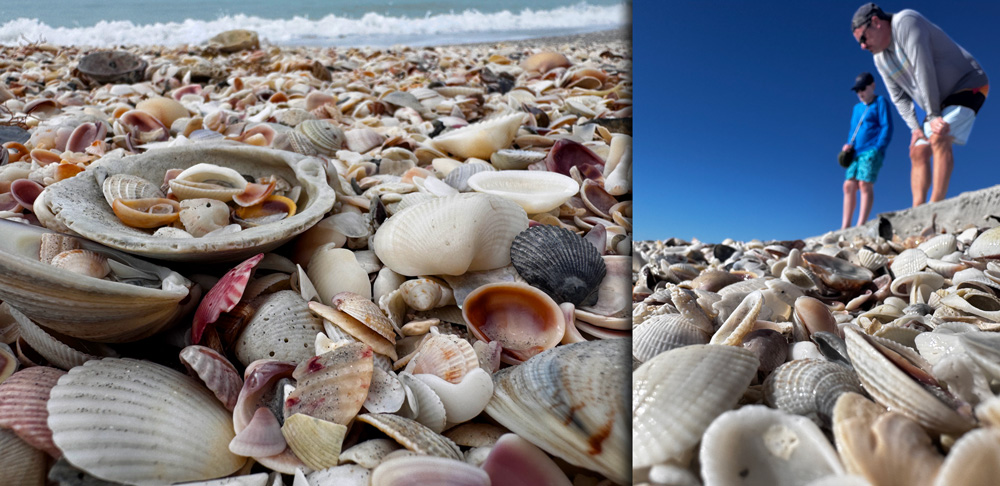
I saw something on a Florida beach that I can’t get out of my mind:
Clear evidence of the inefficiency and wastefulness of God.
It was our first day of vacation on Little Gasparilla Island, a thin sliver of land north of Fort Myers, accessible only by a passenger ferry. I was walking barefoot along the Gulf shore when I saw them.
Piles and piles of seashells.
I’ve seen shells on a beach before, but nothing like this. I’m not sure what a million of anything looks like, but I’m sure there were at least that many. In some places, it looked like someone had dumped dozens of wheelbarrows’ worth of shells in a pile, of all different sizes and types.
I pondered how each one was a tiny, intricate, fragile work of art. Then I considered how each one used to be part of a living thing, made slowly over time like an organic 3D printer by some of the lowest levels of life on our planet.
If the beach were barren but for one of these small shells, you’d think you’d stumbled upon a masterpiece of infinite value.
But it was just one of millions, washed up on this remote stretch of sand that had become a dump site where the ocean discarded great mounds of garbage it no longer needed.
I was struck by the prolific nature of God’s creativity.
And yes, the inefficiency and wastefulness of his generosity.
He paints daily sunrises and sunsets that most people never see. He created insects and fish and animals yet to be discovered. He whipped up galaxies that are beyond our reach. He strews millions of fragile works of art across a beach like they’re no big deal.
I thought of the parable of the sower (Matthew 13:1-23), in which seeds are sown haphazardly over not just fertile ground (as would be prudent), but also among the hard path, rocky places, and thorns. Jesus told us that God is not stingy in scattering His love.
And He proves it in the Eucharist.
We Catholics believe it to be the real body and blood of Jesus. Not a symbol, mind you. Legit. That’s not to say we don’t struggle mightily in getting our bird brains wrapped around this mystery. It’s a difficult thing to accept. Over the centuries, even priests have struggled with doubt.
But doubt is not a sign of faithlessness; it’s a sign we are human.
On this same trip, I read about one of those doubting priests who lived during the 8th century, and the miracle that happened one day while he was saying Mass in Lanciano, Italy. During the consecration, the host in his hands transformed into visible flesh, and the wine in the chalice became real blood.
Twelve hundred years later, the flesh has still not decayed, and the blood clots have not decomposed. It is one of the most studied and scientifically examined miracles in history. Modern testing in the 1970s and 1980s confirmed that it was actual human cardiac tissue belonging to a living person at the moment the sample was taken.
Oh, and the blood had the same rare genetic markers found in the Shroud of Turin, widely considered to be the burial cloth of Jesus.
Now, if a humble host really does transform into the actual body of Jesus Christ during the act of consecration (which I do believe), then it seems prudent that such an event should be bigger than the Super Bowl. I mean, if this is God miraculously taking on human form for our benefit, there should be some hoopla involved, right? Some hype. It’s so remarkable, so significant, so Earth-shattering, that it should be reserved for special occasions. Maybe once every seventy-five years, like Halley’s Comet. No more than once a year, at least. And definitely only at the hands of the Pope.
But no.
Instead, God decides it should happen every second of every day, all over the world, everywhere.
Indeed, with nearly 220,000 parishes spread across continents and time zones, it is estimated that approximately five Catholic Masses begin every second worldwide. At any given moment, roughly 8,000 to 9,000 Masses are happening across the globe. The Eucharist is effectively being celebrated somewhere every second of the day.
And it happens on humble altars at the hands of humble priests all over the world.
Because it happens in silence, we are prone to miss it. And because it is so commonplace, we take it for granted.
And God seems fine with it. Like, He can’t help Himself.
Staggering, inefficient, wasteful generosity.
God is unfathomably prolific.
But He is not stingy with his love.
He scatters it everywhere, every moment of the day, like scores of seashells on a beach.
For us.

Leave a Reply