
Every book has a typo.
I don’t care how prestigious the publisher, how persnickety the author, or how many editors looked it over; there will always be at least one typo.
It’s a law of nature, like gravity, and how whatever line you choose to stand in always becomes the slowest.
Ok, maybe it’s not that ironclad. But it does happen more than you might expect. I even noticed one in my Bible the other day (although it wasn’t the Author’s fault).
Obviously, a professional works to minimize typos as much as possible. A book riddled with errors is the mark of an amateur. It looks careless and detracts from the message or story the author is trying to convey.
I’ve talked about this law with my friend Scott, who writes books like most people change socks. Since then, I’ve seen typos pop up again and again. Instead of raining down condescension upon the world-renowned author and their fancy New York publisher, I just nod and think, “And there it is.”
It happens to the best of us.
But not me.
No, I’ve written seven books (plus all the Kim & Jason comic strips), and have thus far been able to avoid this fate.
Ahem.
Well, I spotted one recently, during a public reading of my new children’s book. It tripped a wire in my mind. Something felt wrong, but I kept going. Afterwards, I looked back at the text, trying to find the problem. I couldn’t, so I figured my brain must have misfired while my mouth was busy saying the words out loud.
Except then it happened again. During another public reading.
Yep.
There is a typo in The Penguin Who Flew, a picture book for children that only has 32 pages and just 527 words.
This article is longer than that.
I published a book with 527 words, but only 526 of them are typed correctly.
(As far as I know.)
I can confirm that the professional editor I hired isn’t to blame, as the final manuscript does not have the error. It must have happened as I typed the copy into the final layout (why didn’t I just copy and paste?!), so the blame falls squarely on my shoulders.
To be fair, 99.8% of the words in the book are totally fine.
Somehow, that doesn’t make the 0.2% burn any less.
And let me tell you, it really bummed me out.
Still does.
But as the person who has stood on stage after stage, declaring into darn near every microphone I’ve been given that every storm cloud contains a silver lining, I had to ask the question:
Now that this has happened, what does this make possible?
Let’s see…
It unleashed an avalanche of embarrassment upon me, that’s for sure. It provided an opportunity to lose face in the eyes of readers, who will conclude that I am a hack who clearly didn’t care enough to proofread his own book. It will confirm to the world once and for all that I am a fraud…
(Wait, this is not helping…)
Then I had this thought: It’s an opportunity to grow in humility. Which, believe it or not, is something I’ve been praying for. In an attempt to become more like some of my spiritual heroes, and more specifically, Jesus, I realized that I have a long way to go in this department.
(If you don’t think God answers prayers…)
So yes, this disaster did make it possible to grow in humility. Strangely, that actually made me feel better about the whole thing.
Then I realized I could grow even more if I told everyone about the typo, publicly, like I’m doing right NOW. I assume most people will have missed it, as I did, the hundred times I read it BEFORE signing off on thousands of dollars of printing to commence.
But now everyone will be alerted. It’s no longer just my little secret.
(Yes, this sounds like a really smart move…)
That said, I have decided not to share where the typo is. Perhaps you can make it a game, or a fun scavenger hunt for your kids that you can use to teach them at least seven valuable lessons.
(See? Another good thing made possible by my blunder!)
When we do the next printing, I will correct it, which will give those who ordered early a collector’s item. It might even be worth more if it’s anything like the “error cards” from the baseball card-collecting days of my youth.
(That’s me doing you a solid, giving you an investment tip, and rewarding my early investors. Order now, while supplies last!)
But please, just do me one favor. When you do find it, don’t email me to tell me. I already know where it is, and I have no gold stars for you. It might seem like it’s helpful to let an author know you found a mistake in their book, but there’s usually not much they can do about it. Plus, no author I’ve ever met is under the illusion that they’ve written the perfect book. Let them reside in the bubble that maybe, just this once, the stars aligned, and they did.
On the other hand, after sharing my embarrassing debacle opportunity to grow in virtue with Scott, he reminded me that when people point out a typo, it means they actually read your book. Which, in today’s attention-deprived world, is just about the best compliment an author can receive.

So, to all the many folks who have sent me anecdotes and pictures of kids (and former kids) who have read and LOVED it and, in a few cases, declared it their new favorite book(!), thank you. It’s gratifying to know that this story about a persistent penguin with an impossible dream has landed the way I’d hoped.
And you know what? Feel free to spread the word about the typo.
Especially to the kids.
Maybe the fact that even the big-shot professional author of their new favorite book makes mistakes will remind them that he is human, just like them. And then maybe it’ll dawn on them that they don’t have to be perfect to achieve their dream, either.
Like Marty the penguin, they only have to give it everything they’ve got.
So remember, friend: every book has a typo.
Every life has them, too.
Just don’t let them stop you from making something great.
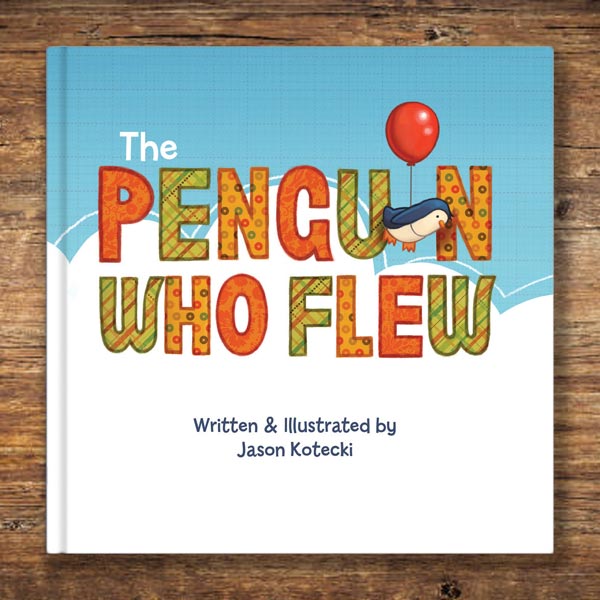
Hurry! Only a limited number of typo-enhanced copies are still available!


Leave a Reply