
As a professional speaker, casinos are my least favorite places to speak. Even if I’m just trying to get to the meeting room, I have to walk through the gaming area. They’re designed that way.
Gambling isn’t my thing, but I understand it can be fun entertainment with friends at night or on the weekend. However, I get super judgey and depressed walking through the maze of slot machines in the middle of a weekday. I see a lot of people, but they’re not with friends, and they don’t appear to be having fun. They seem more like sedentary zombies, desperate not for brains, but riches.
In those moments, the Pharisee who looked down at the tax collector becomes my spirit animal. I think, “Thank God I am not like these sad, lost, gamblers. I am here to do good works, and put my tithes in your coffers, not these unclean slot machines.”
I’m not proud of it; just trying to be honest.
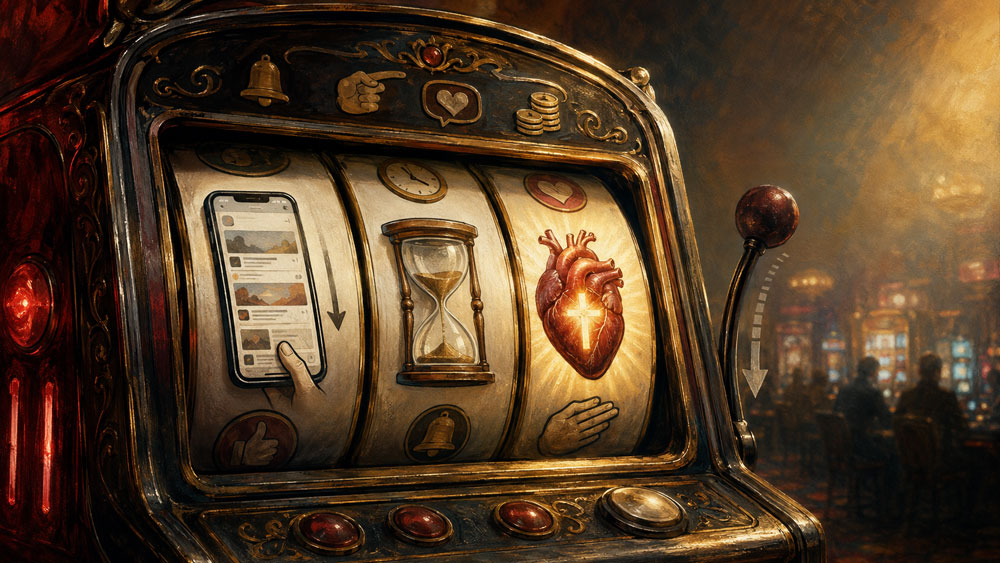
Humility came recently, when I was on my phone, lost in an endless scroll session. (Just me?) As I pulled down on the screen to refresh the content, hoping for something thrilling to appear, the lever-like gesture reminded me of…a slot machine.
The Holy Spirit invaded my Pharisaical heart with a mighty wind: When I scroll social media, how am I any different from the sad people I scoff at for wasting away at slot machines?
Gulp.
Meta recently settled a landmark trial for $17.1 billion over claims that Instagram and Facebook were designed to be addictive to minors.
The hilarious part about that last sentence is the bit about “minors,” as if they are the only ones in the crosshairs.
Indeed, very smart people have used the very same strategies casinos use to lure people to spend more money to get us to spend more time on our phones. Both use vibrant colors, animation, vibration, and sounds to make small interactions feel like big deals.
They both have an uncertain payoff, too. We scroll, flipping past posts that don’t grab our attention. But then! Something piques our curiosity and rewards us with a laugh, a piece of trivia to share with friends, or a burst of outrage that fires us up. Meanwhile, social rewards—likes, comments, and messages—feed our ego. Dopamine hits, every last one.
The intermittent nature of the reward makes checking more persistent — and addictive — than if the outcome were predictable.
At the risk of making this seem like a vilification of smartphones, let me share some thoughts before getting to my real point.
Like any tool, the smartphone can be used for good or bad purposes. It can help connect us to one another and draw us closer to God. It can also divide us and lead us away from Him.
Odds are you’re already aware of strategies to manage your smartphone use, such as keeping it out of reach during activities you want to protect—reading, conversation, workouts, and sleep. Here are a few more under-the-radar tips:
• Turn off nonessential notifications, especially social, shopping, and news alerts. (Every app is desperate to have you turn them on the minute you start using it.)
• Replace open-ended feeds with bounded alternatives like saved articles, specific podcast episodes, or messages from a chosen person.
• Switch your phone to grayscale mode. Studies show we spend less time on our phones when they’re not candy-colored.
• Before you reach for your phone, make the Sign of the Cross.
We can all probably get better at using our phones rather than letting them use us. But now to the real point, which isn’t about our smartphones.
It’s about our self-perception.
There are lots of stories in the Bible, many delivered by Jesus in the form of parables. No one likes to imagine themselves as the “bad guy” in the story.
Archbishop Fulton Sheen once noted our tendency to divide the world’s population into the “nice” and the “nasty.” Of course, we might acknowledge that we may not be perfect, but compared to the nastiness of those other people…
Associating my smartphone to a slot machine made me realize I was the haughty Pharisee in Jesus’ story, and like the repentant Tax Collector, I cried, “Lord, have mercy on me, a sinner!”
The old adage warns us about pointing fingers, as there are always three pointing back at us, sometimes pointing at different things that are even worse.
I may not spend my free time at casinos, but I carry a slot machine in my pocket daily.
Mindlessly using it is like sleepwalking, and in my distracted, zombie-like state, I am not alert enough to hear the Holy Spirit’s gentle whispers.
I’m not wasting money, but I am wasting time. Which is more valuable in the end?
Fulton Sheen offers some encouragement for us: “The nasty people are the convertible people; aware of their own imperfections, they sense within themselves an emptiness…. Our Blessed Lord was very fond of nasty people.”
So consider this a friendly neighborhood reminder not to gloss over those familiar stories so quickly, while automatically placing yourself in the camp of the righteous.
Sheen reminds us, “Nice people must see themselves as nasty people before they can find peace.”
The benefit of finding a little of yourself in the “bad guy” is so that you’ll be humbled into throwing yourself at the feet of a good God.

Leave a Reply